
IIT Bombay Rank Calculator
IIT Bombay Admission Requirements
Based on the latest data: Less than 1% of JEE Advanced aspirants get into IIT Bombay. For Computer Science, you need a rank under 100 in the general category. For OBC-NCL, the cutoff is around 280.
Admission Status
Understanding the Competition
With over 200,000 students taking JEE Advanced, only about 1,800 get into IIT Bombay. For Computer Science, this means the top 78 students in the general category get in. This represents less than 0.05% of all JEE Advanced candidates.
Getting into IIT Bombay isn’t just hard-it’s one of the toughest academic challenges a student in India can take on. Every year, over 200,000 students take JEE Advanced. Only about 10,000 make it into any IIT. And of those, fewer than 1,800 get into IIT Bombay. That’s less than 1% of everyone who starts the journey. This isn’t about studying harder. It’s about studying smarter, longer, and under pressure most people can’t imagine.
What Does It Really Take to Get In?
First, you need to clear JEE Main. That’s the first filter. Only the top 2,50,000 scorers get to sit for JEE Advanced. But even clearing JEE Advanced doesn’t guarantee a seat at IIT Bombay. You need a rank under 1,800 in the general category. For reserved categories, the cutoffs are higher, but the competition is just as fierce because seats are limited.
Let’s say you’re aiming for Computer Science-the most popular branch at IIT Bombay. In 2024, the closing rank was 78 for the general category. That means you had to be in the top 78 students out of 200,000+ who took JEE Advanced. If you’re from a different category, like OBC-NCL, the cutoff was around 280. Still, that’s top 0.15% of all test-takers.
It’s not just about marks. It’s about consistency. One bad day, one misread question, one moment of panic-and you could drop 100 ranks. There’s no room for error. You need to nail every subject: Physics, Chemistry, and Math-all at an advanced level.
The Real Competition: Who Else Is in the Race?
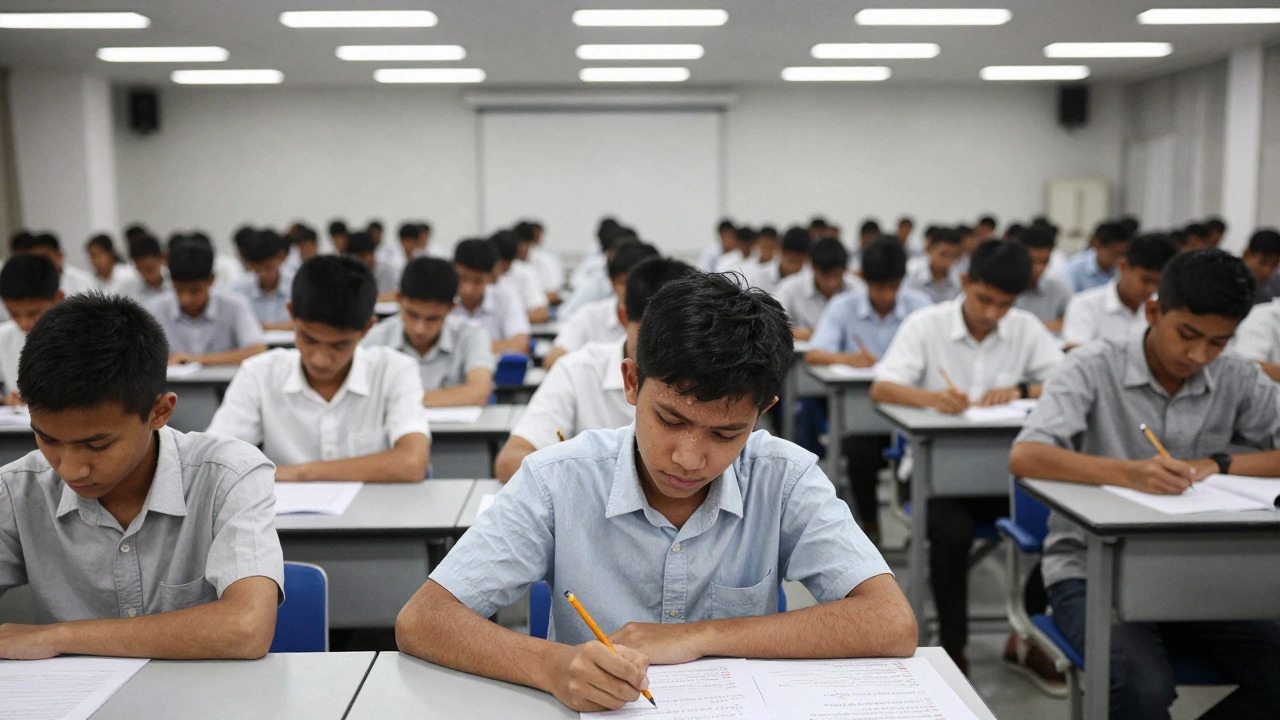
Think you’re working hard? So are 199,999 other students. Many of them start preparing in Class 8. Some join coaching centers as early as Class 9. They wake up at 5 a.m., study until midnight, and take weekly mock tests that mimic JEE Advanced’s brutal difficulty.
And it’s not just Indian students. A growing number of Non-Resident Indians (NRIs) and international students are applying through the DASA scheme. While DASA has its own cutoffs, the competition for IIT Bombay seats under this route is still intense. In 2024, over 3,000 DASA applicants competed for just 60 seats at IIT Bombay. That’s a 2% acceptance rate.
Even among top coaching institutes like Allen, Resonance, or FIITJEE, only a handful of students each year crack the top 100. Most coaching centers have 500+ students per batch. Only 1 or 2 make it into IIT Bombay’s top branches.
What Subjects Do You Need to Master?
JEE Advanced doesn’t test what you memorized. It tests how well you think under pressure. Here’s what you’re really up against:
- Physics: Expect problems that combine multiple concepts-like rotational motion with electromagnetism. You won’t find direct formulas. You’ll need to derive them on the spot.
- Chemistry: Organic chemistry questions are tricky. You’ll be asked to predict reaction mechanisms for compounds you’ve never seen. Inorganic chemistry demands memorization of exceptions and trends-but even then, questions are designed to trip you up.
- Mathematics: This is where most students fall. Calculus problems are layered. You’ll need to solve integrals with hidden substitutions. Algebra questions involve complex number geometry. Probability isn’t about coin tosses-it’s about conditional events in real-world scenarios.
A 2023 analysis of JEE Advanced papers showed that 42% of Physics questions required multi-step reasoning. In Math, 58% of problems needed students to combine at least three concepts. There’s no shortcut. You can’t rely on guesswork. You need deep understanding.
How Much Time Do You Need?
Most students who make it into IIT Bombay have spent 2-3 years preparing full-time. That’s 10-12 hours a day, six days a week. It’s not about how many books you’ve read. It’s about how many problems you’ve solved.
Top performers typically solve 150-200 problems per day across all subjects. That’s over 50,000 problems in two years. And they don’t just solve them-they analyze every mistake. They keep error logs. They revisit weak topics weekly. They simulate exam conditions with timed mock tests every weekend.
One student from Hyderabad, who got into IIT Bombay’s Electrical Engineering program in 2024, told his coach: "I didn’t study more than others. I just didn’t skip a single day of practice for 700 days straight."
What About Coaching? Is It Necessary?
Coaching isn’t mandatory, but it’s nearly universal among successful candidates. Over 92% of IIT Bombay admittees in the past five years attended a coaching center. Why? Because coaching gives you structure, exposure to high-level problems, and feedback you can’t get from books alone.
But coaching alone won’t save you. Many students pay ₹1.5 lakh per year for coaching and still fail. The difference? Discipline. The students who succeed use coaching as a tool-not a crutch. They take initiative. They ask questions. They don’t wait to be taught-they learn on their own.
Self-study is possible. There are stories of students from small towns who cracked JEE Advanced with only NCERT books and YouTube videos. But those students were relentless. They had no distractions. They had no safety net. They studied in silence, often without internet, sometimes without even a proper desk.
The Mental Game: Stress, Burnout, and Failure
Most people don’t talk about this. But the hardest part of getting into IIT Bombay isn’t the syllabus. It’s the mental toll.
One in three students preparing for JEE Advanced shows signs of anxiety or depression. Parents push. Teachers push. Friends compare. Social media shows everyone else getting better. You start doubting yourself after every mock test.
And then there’s failure. Many top students fail once. Some fail twice. A 2024 survey by IIT Bombay’s student council found that 38% of current first-year students had taken JEE Advanced twice before getting in. One student took it three times. He didn’t get into IIT Bombay the first two times. He got into a state college. He kept going. And on his third attempt, he cracked it.
Resilience matters more than IQ. If you can handle rejection, keep showing up, and learn from every mistake-you have a shot.
What Happens If You Don’t Get In?
Not getting into IIT Bombay doesn’t mean you failed. It means you didn’t win a very narrow race. There are other great options: IIT Delhi, IIT Madras, NIT Trichy, IIIT Hyderabad, or even top private colleges like BITS Pilani. Many of these schools have better placement records than some IIT branches.
And here’s the truth: IIT Bombay is not the only path to success. Engineers from non-IIT colleges are working at Google, Microsoft, and Tesla. Startups founded by non-IIT grads have raised billions. The world doesn’t care which college you went to-it cares what you built, what you learned, and how you solved problems.
But if your goal is IIT Bombay? Then you need to treat it like a mission. Not a dream. A mission.
Final Reality Check
Let’s say you’re in Class 11. You want IIT Bombay. Here’s what you need to do right now:
- Master NCERT for Physics, Chemistry, and Math. No exceptions.
- Start solving previous years’ JEE Advanced papers-starting with 2015. Don’t skip a single year.
- Take one full mock test every week. Analyze every wrong answer.
- Build a habit: 7 hours of focused study daily. No distractions. No phone.
- Find one mentor-teacher, senior, or online coach-who will give you honest feedback.
- Accept that you will fail. Then get up and try again.
It’s not about being the smartest. It’s about being the most consistent. The most disciplined. The one who shows up even when no one is watching.
Getting into IIT Bombay is hard. But if you’re willing to pay the price, it’s not impossible.
What is the minimum rank needed to get into IIT Bombay?
For the general category, you typically need a rank under 1,800 in JEE Advanced to get into any branch at IIT Bombay. For top branches like Computer Science, the cutoff is often under 100. For reserved categories, the rank cutoff is higher but still highly competitive-usually under 500 for OBC-NCL and under 1,500 for SC/ST.
Can I get into IIT Bombay without coaching?
Yes, but it’s rare. Less than 8% of IIT Bombay admittees in the last five years didn’t use coaching. These students usually had strong foundational knowledge, access to quality study materials, and exceptional self-discipline. They solved thousands of problems, tracked every mistake, and took full mock tests under exam conditions. Coaching helps, but it’s not a magic solution-your effort matters more.
How many hours should I study daily to crack IIT Bombay?
Top performers typically study 8-10 hours a day, six days a week, for two full years. But it’s not just about hours-it’s about focused, deliberate practice. Solving 150-200 high-quality problems daily, reviewing mistakes, and taking weekly mocks matters more than just sitting at a desk for 12 hours.
Is JEE Advanced harder than IIT JEE Main?
Yes, significantly. JEE Main tests basic understanding and speed. JEE Advanced tests deep conceptual clarity, multi-step problem-solving, and the ability to apply knowledge in unfamiliar situations. Around 60% of JEE Advanced questions require combining two or more concepts. Only 1 in 10 JEE Main qualifiers clears JEE Advanced.
What percentage of students who take JEE Advanced get into IIT Bombay?
Out of roughly 200,000 students who take JEE Advanced each year, only about 1,800 get into IIT Bombay. That’s less than 1%. For Computer Science, the acceptance rate drops to under 0.05%-just 78 students out of 200,000.
Do I need to be a genius to get into IIT Bombay?
No. Most students who get in aren’t geniuses-they’re persistent. They make mistakes, learn from them, and keep going. IQ matters less than consistency, time management, and emotional resilience. The student who studies 8 hours a day for 700 days straight will beat the one who studies 12 hours for 300 days and then burns out.
What Comes After Getting In?
Getting into IIT Bombay is just the beginning. The first year is brutal. The academic load is heavier than most students expect. You’ll be surrounded by peers who scored even higher than you. The pressure doesn’t disappear-it changes shape.
But if you make it through, you’ll be part of a network that opens doors globally. Companies like Google, Apple, and Goldman Sachs recruit directly from IIT Bombay. Research labs around the world welcome IIT Bombay graduates. And the alumni network? It’s one of the strongest in Asia.
So yes-it’s hard. But if you’re ready to fight for it, every hour, every problem, every failure is worth it.

Anirudh Vaidya
I am an education consultant specializing in the Indian education system, and I enjoy exploring innovative teaching methods. My passion is writing about educational reforms and developments happening in India, trying to bring awareness to global audiences. I regularly contribute to various educational journals and participate in conferences worldwide. I believe in lifelong learning and am always keen to exchange ideas with fellow educators.