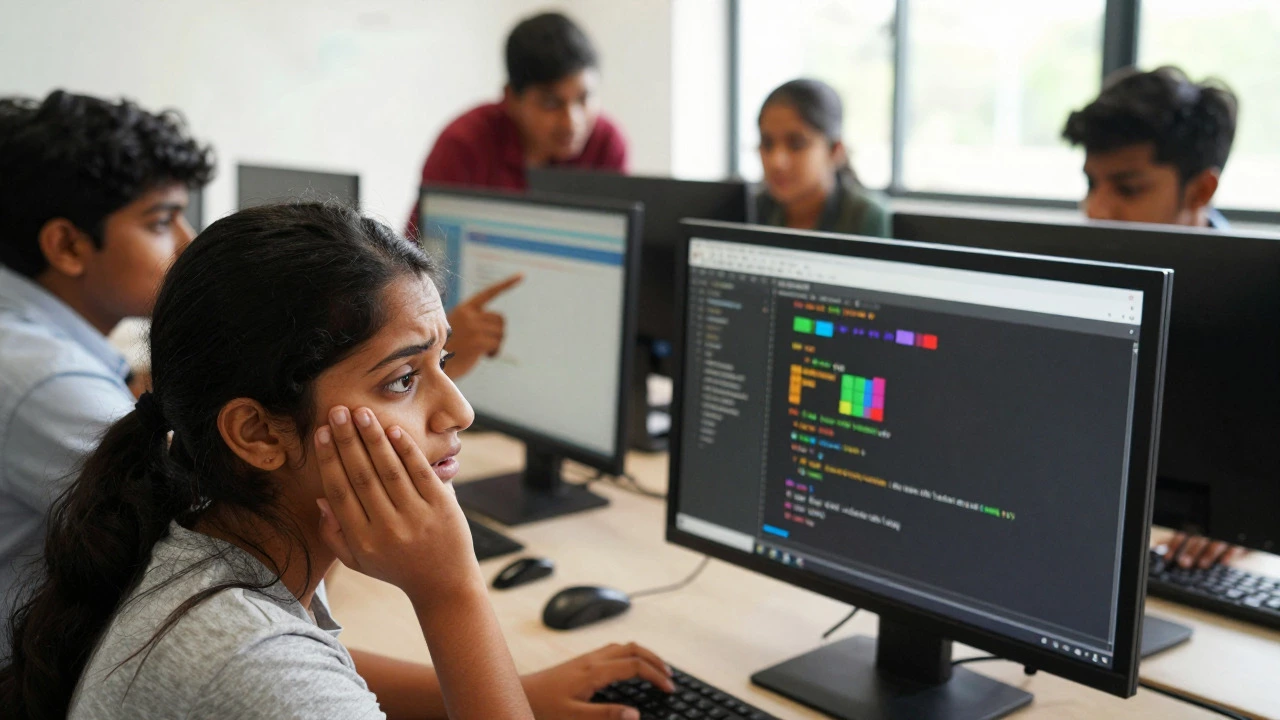
Coding & Math Myth-Buster Quiz
Loading question...
Quiz Complete!
You scored out of 5.
You’ve probably heard it a thousand times: "You need to be good at math to become a programmer." It’s the first objection most people raise when they think about switching careers or starting coding classes. Maybe you struggled with calculus in high school, or maybe you just prefer writing essays to solving equations. Does that mean you’re locked out of the tech world?
Here is the short answer: No. But the long answer is where things get interesting. While coding and math share DNA, they aren’t twins. In fact, many professional developers use barely any advanced mathematics in their daily work. If you are worried that your lack of algebra skills will stop you from building apps or websites, take a breath. We are going to break down exactly what kind of "math" you actually need, where the myths come from, and how you can succeed without being a human calculator.
The Big Misconception: Arithmetic vs. Logic
When people say "math," they usually mean arithmetic-adding, subtracting, multiplying, and dividing numbers. Or worse, they mean complex calculus and trigonometry. If you hate those subjects, you might assume coding is off-limits. But here is the reality check: modern programming languages handle the heavy lifting for you. You don’t write code to calculate the square root of 49; you call a function like `Math.sqrt(49)` and let the computer do the work.
What coding actually demands is logical reasoning, which is the ability to break down a problem into small, sequential steps and identify patterns. Think of it less like solving an equation and more like writing a recipe. If you can follow instructions like "preheat oven, mix flour, bake for 20 minutes," you have the core skill set needed for programming. This logical structure is often called computational thinking, and it is distinct from traditional mathematical computation.
Where Math Actually Shows Up in Code
So, if you aren’t doing long division, where does math hide in programming? It appears mostly in two areas: data manipulation and specific application domains. Let’s look at concrete examples so you know what to expect.
- Basic Operations: You will constantly use addition (+), subtraction (-), multiplication (*), and division (/). If you can manage a grocery budget, you can handle this part of coding.
- Modulo Operator (%): This gives you the remainder of a division. It sounds scary, but it’s simple. For example, 10 % 3 equals 1 because 3 goes into 10 three times with 1 left over. Developers use this all the time for things like alternating colors in a table row (even rows one color, odd rows another).
- Boolean Logic: This is true/false logic. Statements like "If user is logged in AND has admin rights, show dashboard" rely on Boolean operators (AND, OR, NOT). This is closer to philosophy or debate than it is to geometry.
- Coordinates: Web development uses X and Y coordinates for positioning elements on a screen. If you understand grid paper concepts, you’re already ahead.
Notice anything missing? There is no calculus, no integrals, and no differential equations in these everyday tasks. Most front-end web development, mobile app creation, and database management require very little beyond basic arithmetic and logic.

When Do You Need Serious Math?
It would be dishonest to say math never matters. Certain niches within programming are heavily dependent on higher-level mathematics. If you choose these paths, you will need to brush up on your skills. Here is a breakdown of which roles require which types of math.
| Role / Domain | Math Level Required | Specific Concepts Used |
|---|---|---|
| Web Development (Front-End) | Low | Basic arithmetic, percentages, RGB color values |
| Data Analysis | Medium | Statistics, averages, standard deviation, probability |
| Game Development | High | Trigonometry, vectors, physics simulations |
| Machine Learning / AI | Very High | Linear algebra, calculus, statistics, probability theory |
| Cryptography | High | Number theory, prime factorization, modular arithmetic |
If you want to build a website for a local bakery or create a mobile app for tracking habits, you likely won’t touch linear algebra. However, if you aim to train neural networks for self-driving cars, you better enjoy matrices. The key is knowing your goal. Don’t let fear of calculus stop you from learning Python for data cleaning, but don’t ignore math if you want to specialize in algorithmic trading.
Logic Is the Real Skill You Need
Since we’ve established that arithmetic isn’t the barrier, what is? It’s logic. Specifically, it’s the ability to think sequentially and handle edge cases. Imagine you are teaching a robot to make coffee. You must specify every step: pick up cup, pour water, insert pod, press button. If you forget to say "turn on machine," the robot fails. This is debugging in real life.
Programming involves creating loops (doing something repeatedly) and conditionals (making decisions based on rules). These structures mirror logical arguments. Consider this pseudocode:
IF temperature > 30 THEN
    wear shorts
ELSE
    wear jeans
END IF
This isn’t math. It’s decision-making. Many students who struggle with abstract math formulas excel at coding because they enjoy clear, rule-based systems. If you like puzzles, Sudoku, or strategy games, you likely have the aptitude for programming logic. The mental muscle you build by practicing coding exercises strengthens your logical reasoning, which can actually help you understand math better later on, not the other way around.
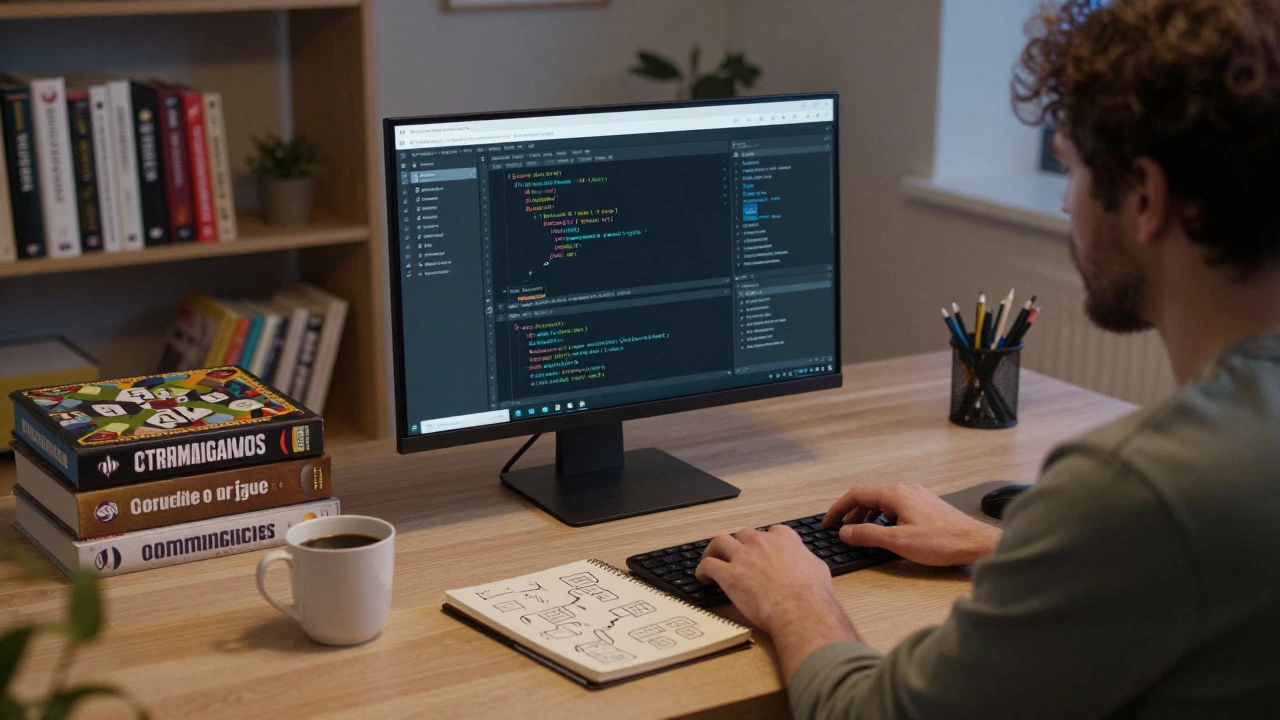
How to Start Coding Without Fear
If you are ready to try coding classes but feel intimidated by the math question, here is a practical roadmap to ease your anxiety.
- Pick a Visual Language First: Start with Scratch or HTML/CSS. These tools let you see immediate visual results without worrying about variables or functions initially. It builds confidence.
- Focus on Problem-Solving, Not Syntax: When learning Python or JavaScript, spend more time understanding *why* a loop works rather than memorizing exact punctuation. Logic transfers across languages; syntax does not.
- Use Interactive Platforms: Tools like Codecademy or freeCodeCamp provide instant feedback. They treat coding like a game with levels, which makes the logical progression feel natural rather than academic.
- Avoid Heavy Math Initially: Choose projects that involve text, images, or simple databases. Build a to-do list app or a personal blog before trying to build a physics engine.
Remember, even professional developers look up syntax and basic algorithms regularly. You don’t need to memorize every formula. You need to know how to find solutions and connect ideas logically.
Final Thoughts: Your Brain Is Enough
Does coding involve math? Yes, but only as much as cooking involves chemistry. You can cook a delicious meal without knowing the molecular structure of protein denaturation. Similarly, you can build robust software applications without mastering calculus. The myth that coding is reserved for math geniuses keeps talented creatives and logical thinkers out of the industry unnecessarily.
Your ability to communicate clearly, break down problems, and persist through errors matters far more than your grade in AP Statistics. So, if you are curious about tech, sign up for that introductory course. Bring your logic, leave your fear of numbers at the door, and see where it takes you.
Do I need calculus to learn Python?
No, you do not need calculus to learn Python for general purposes. Basic Python scripting, web scraping, automation, and data cleaning require only basic arithmetic and logical thinking. Calculus becomes necessary only if you move into scientific computing, machine learning, or physics simulations using libraries like NumPy or SciPy.
Is coding harder than math?
This depends on your strengths. People who enjoy abstract symbols and rigid formulas may find math easier. People who enjoy building things, seeing immediate results, and troubleshooting logical flows often find coding easier. Coding is more creative and iterative, while traditional math is often more static and theoretical.
Can I become a developer if I failed math in school?
Absolutely. Many successful developers had average or poor grades in high school math. Success in coding relies more on persistence, attention to detail, and logical structuring than on numerical proficiency. Focus on improving your problem-solving skills rather than worrying about past math performance.
Which programming language requires the least math?
HTML and CSS are markup and styling languages, respectively, requiring almost no math. JavaScript and Python are beginner-friendly programming languages that allow you to start with minimal mathematical knowledge. SQL (Structured Query Language) for databases also requires very little math, focusing instead on logical filtering and sorting of data.
Does machine learning require advanced math?
Yes, deep understanding of machine learning requires advanced math, specifically linear algebra, calculus, and statistics. However, you can use pre-built machine learning models via APIs or high-level libraries like TensorFlow without deeply understanding the underlying math initially. To customize models effectively, however, the math knowledge becomes essential.

Anirudh Vaidya
I am an education consultant specializing in the Indian education system, and I enjoy exploring innovative teaching methods. My passion is writing about educational reforms and developments happening in India, trying to bring awareness to global audiences. I regularly contribute to various educational journals and participate in conferences worldwide. I believe in lifelong learning and am always keen to exchange ideas with fellow educators.