
JEE Subject Strategy & Score Optimizer
Enter Your Mock Test Accuracy Rates
Input the percentage of questions you answered correctly in recent mock tests for each subject.
Estimated Overall Score
Physics
Chemistry
Mathematics
🎯 Personalized Study Strategy
You sit down to solve a mock test. You crush the Chemistry section in twenty minutes. You spend an hour on Physics, getting half right. Then you look at Mathematics. It stares back at you, complex and unforgiving. This is the reality for thousands of aspirants preparing for the JEE (Joint Entrance Examination).
The question "What is the most scoring subject in JEE?" doesn't have a single answer because it depends entirely on your strengths and the specific exam pattern of that year. However, data from recent years tells a clear story about where points are easiest to grab and where they are hardest to keep.
The General Consensus: Why Chemistry Is Often Called the "Scoring" Subject
If you ask coaching institutes or top rankers, many will point to Chemistry as the most scoring subject. But this needs nuance. Chemistry isn't one subject; it's three distinct games packed into one paper.
Physical Chemistry involves calculations similar to Physics but usually with simpler formulas. If you understand the concepts like mole concept, thermodynamics, and electrochemistry, you can score full marks here with minimal effort compared to other sections.
Inorganic Chemistry is pure memory work. Periodic table trends, chemical bonding, coordination compounds, and general organic chemistry require reading NCERT textbooks line by line. There is no shortcut. If you memorize it, you get the marks. It is high-effort upfront but low-effort during the exam.
Organic Chemistry sits in the middle. It requires logic and reaction mechanisms. Once you master the basics of GOC (General Organic Chemistry) and name reactions, you can predict outcomes without rote learning.
So, why is Chemistry considered "scoring"? Because the questions are often direct. In JEE Main, especially, if you know the fact or the formula, you get the mark. There is less ambiguity than in Mathematics and less variable complexity than in Physics.
The High-Risk, High-Reward Zone: Mathematics
Mathematics in JEE is notorious. For many students, it is the lowest-scoring subject. Why? Because the syllabus is vast, and the calculation intensity is high. A small arithmetic error in a long integration problem can cost you four marks.
However, for students who are strong in math, this section becomes the biggest advantage. When others are stuck on a tricky calculus problem, you might breeze through matrices, determinants, or vector algebra. These topics are formula-based and quick to solve.
The key to making Math scoring is topic selection. Don't try to be perfect in everything. Focus on high-weightage, low-complexity chapters:
- Matrices and Determinants
- Vectors and 3D Geometry
- Probability
- Complex Numbers
If you ignore these "easy" topics to focus on hard Calculus, you are leaving free marks on the table. Mathematics is not inherently unscoring; it is just unforgiving of carelessness.
Physics: The Conceptual Balancer
Physics is often seen as the bridge between Math and Chemistry. It requires mathematical application but relies heavily on conceptual understanding. You cannot bluff your way through a Mechanics problem.
In recent years, Physics has become more predictable. Many questions come directly from standard concepts like Modern Physics, Semiconductors, and Current Electricity. These chapters have fixed formulas and limited variables. If you practice numerical problems regularly, Physics can consistently yield 60-70% accuracy.
The danger in Physics is time management. One tough Rotational Motion or Electrostatics problem can consume thirty minutes. If you get stuck, you panic. The best strategy is to identify the "quick wins" in Physics-topics like Units and Dimensions, Error Analysis, and Optics-and secure those first.
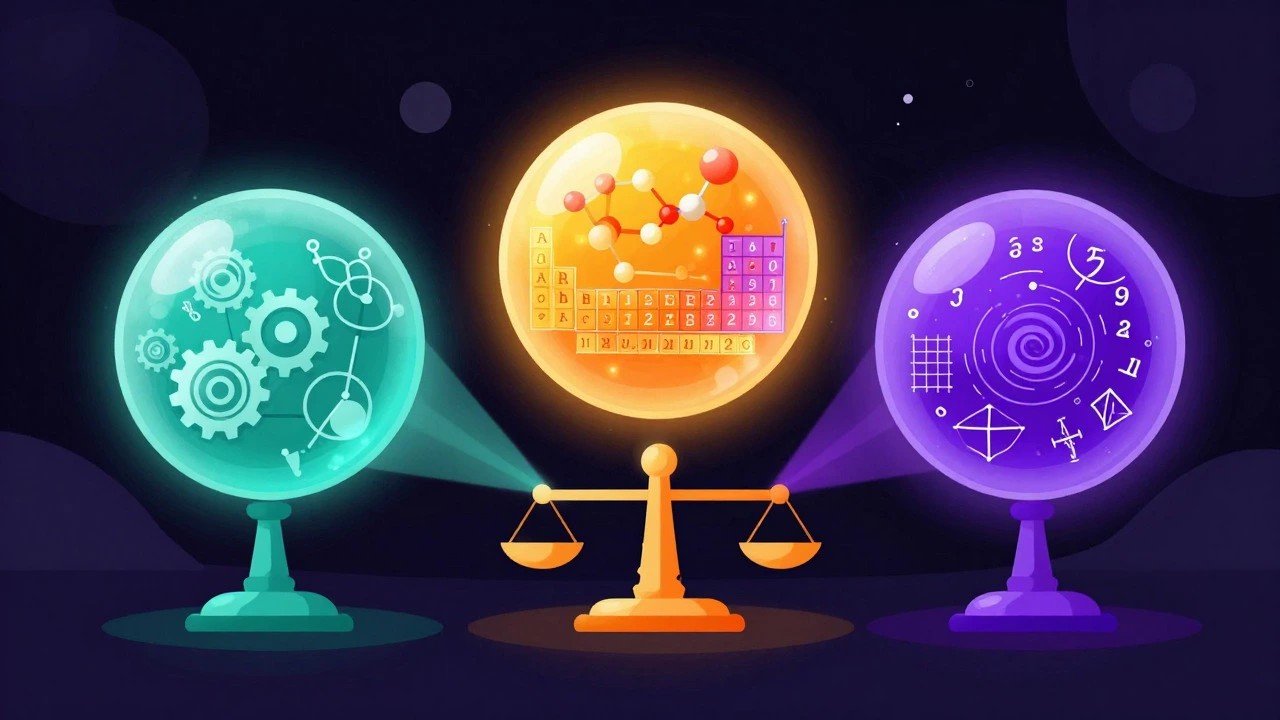
Comparing the Subjects: A Strategic Breakdown
To understand which subject works for you, let's look at the attributes of each. This comparison helps in deciding where to invest your study hours.
| Attribute | Physics | Chemistry | Mathematics |
|---|---|---|---|
| Primary Skill Required | Conceptual Application | Memory + Logic | Calculation Speed |
| Time per Question (Avg) | 4-5 Minutes | 1-2 Minutes | 5-7 Minutes |
| Error Impact | Medium | Low | High |
| Consistency Level | Moderate | High | Variable |
| Best For | Logical Thinkers | Diligent Readers | Fast Calculators |
Notice the "Error Impact" row. In Chemistry, if you misremember a color change in a qualitative analysis test, you lose one mark. In Math, if you drop a negative sign in a differential equation, you might lose marks across multiple dependent steps. This makes Chemistry safer for building a base score.
The Role of JEE Main vs. JEE Advanced
Your strategy changes depending on which exam you are targeting. JEE Main is largely factual and formula-based. Here, Chemistry is king. Questions are straightforward, and NCERT coverage is sufficient for a large chunk of the paper.
JEE Advanced is different. It tests depth. In Advanced, Chemistry questions are multi-conceptual. You might need to combine Organic mechanisms with Physical Chemistry calculations. Math in Advanced is less about speed and more about clever shortcuts and logical leaps. Physics in Advanced often involves linked comprehension sets that test your ability to handle new information.
For JEE Main, aim for maximum accuracy in Chemistry and moderate accuracy in Physics and Math. For JEE Advanced, you need balanced strength across all three, with a slight edge in whichever subject aligns with your natural aptitude.

How to Identify Your Personal "Most Scoring" Subject
Don't guess. Test yourself. Take five full-length mock tests under timed conditions. Analyze the results not by total score, but by accuracy percentage in each subject.
If you get 80% accuracy in Chemistry, 60% in Physics, and 40% in Math, then Chemistry is your most scoring subject. Prioritize maintaining that accuracy while trying to bring Physics up to 70%. Don't waste time trying to make Math your strongest suit if your accuracy stays below 50%.
Use the "Effort-to-Reward Ratio." Ask yourself: "How many hours did I study this chapter versus how many marks did I get?" If you spent 10 hours on Integration and got 2 marks, but spent 2 hours on Chemical Bonding and got 4 marks, shift your focus. Efficiency beats intensity in competitive exams.
Common Pitfalls to Avoid
Many students fall into the trap of ignoring their weak subject completely. They think, "I'll just ace Physics and Chemistry." This is dangerous. In JEE, even a poor performance in Math can drag your rank down significantly because the cutoff is holistic. You don't need to be great in all three, but you must be competent in all three.
Another mistake is over-relying on shortcuts. Shortcuts work when you understand the underlying concept. If you memorize a trick for finding eigenvalues without understanding matrices, you will fail when the question is twisted slightly. Always prioritize concept clarity over speed initially.
Strategic Study Plan for Maximum Score
To maximize your score, adopt a tiered approach:
- Foundation Phase: Cover NCERT thoroughly for Chemistry. Solve basic problems for Physics and Math to build confidence.
- Strengthening Phase: Identify high-weightage topics in each subject. For example, Thermodynamics in Chemistry, Mechanics in Physics, and Calculus in Math. Master these.
- Mock Test Phase: Simulate exam conditions. Practice skipping difficult questions. Learn to manage negative marking.
- Revision Phase: Focus on formulas, reactions, and diagrams. This is crucial for Chemistry and Physics.
Remember, the "most scoring" subject is the one you prepare smartest. If you put in consistent, focused effort, any subject can become your strength.
Is Chemistry really the easiest subject in JEE?
Chemistry is often considered the easiest to score in because many questions are direct recall or simple application of formulas, especially in JEE Main. However, "easiest" is subjective. For students who struggle with memorization, Inorganic Chemistry can be challenging. For those weak in logic, Organic Chemistry can be tough. But generally, the time-per-question ratio is better in Chemistry than in Math or Physics.
Which subject has the highest weightage in JEE?
In both JEE Main and JEE Advanced, Physics, Chemistry, and Mathematics carry equal weightage. Each subject contributes equally to the total score. Therefore, neglecting any one subject can severely impact your overall rank, regardless of how well you perform in the others.
Can I crack JEE by focusing only on two subjects?
It is risky. While some exceptional candidates have cracked JEE with a weakness in one subject, it requires near-perfect scores in the other two. Given the competition and the variability of question difficulty, a balanced approach is safer. Aim for at least average competence in all three subjects to ensure a stable rank.
Why do students find Mathematics difficult in JEE?
Mathematics in JEE is difficult due to its vast syllabus, high calculation intensity, and the potential for small errors to lead to wrong answers. Topics like Calculus and Coordinate Geometry require deep conceptual understanding and practice. Additionally, the time pressure makes it hard to complete lengthy mathematical derivations accurately.
How important is NCERT for JEE preparation?
NCERT is extremely important, especially for Chemistry. Many questions in JEE Main are directly framed from NCERT lines and examples. For Physics and Math, NCERT provides the foundational concepts, though you will need additional reference books for advanced problem-solving required in JEE Advanced.

Anirudh Vaidya
I am an education consultant specializing in the Indian education system, and I enjoy exploring innovative teaching methods. My passion is writing about educational reforms and developments happening in India, trying to bring awareness to global audiences. I regularly contribute to various educational journals and participate in conferences worldwide. I believe in lifelong learning and am always keen to exchange ideas with fellow educators.