
English Fluency Timeline Estimator
Your Learning Parameters
Milestone Roadmap
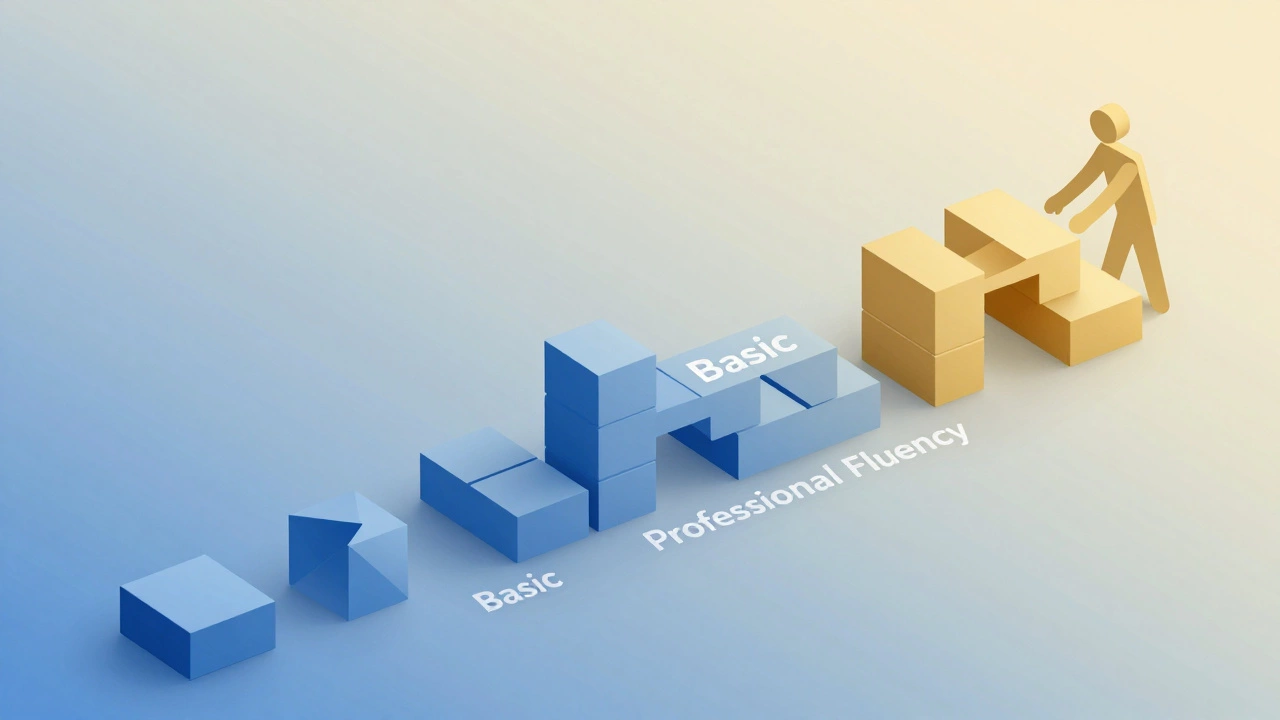
Conversational Fluency
Able to hold simple conversations, order food, and handle daily tasks. Grammar mistakes are present but understandable.
Professional Fluency
Can lead meetings, negotiate contracts, and discuss abstract ideas clearly without frequent pauses.
Native-like Fluency
Understanding idioms, cultural references, and rapid speech. Requires long-term immersion.
Recommended Strategy
Adjust the sliders and settings to see your personalized roadmap.
You’ve probably seen the ads promising you’ll be fluent in English in just 30 days. Maybe you’ve heard friends claim they mastered the language in three months. It’s tempting to believe there’s a magic number-a specific count of days that unlocks fluency like a video game level. But here is the hard truth: no one can give you an exact number of days because fluency isn’t a switch you flip; it’s a skill you build, brick by brick.
Still, you need a realistic target. You want to know if you should plan for six months or two years. The answer depends entirely on your starting point, how much time you invest daily, and what “fluency” actually means to you. Let’s cut through the noise and look at the data, the methods, and the real-world timelines that work.
Defining Fluency: What Are You Actually Aiming For?
Before counting days, we have to define the finish line. In language learning, Fluency is the ability to communicate ideas smoothly and confidently without frequent pauses or translation in your head. However, this looks different depending on who you ask.
If you are aiming for basic conversational fluency-ordering food, asking for directions, making small talk with colleagues-you might reach this in a few months. If you want professional fluency-leading meetings, negotiating contracts, understanding nuanced humor-that takes significantly longer. Most learners confuse these two goals, which leads to frustration when they don’t see immediate results.
- Conversational Fluency: You can hold a simple conversation about daily life. You make grammar mistakes, but people understand you.
- Professional Fluency: You can discuss complex topics, use industry-specific vocabulary, and express abstract ideas clearly.
- Native-like Fluency: You understand idioms, cultural references, and rapid speech. This often takes years of immersion.
Knowing which bucket you fall into helps you set a realistic timeline. For most students taking English speaking courses are designed to bridge the gap between beginner and professional levels, the goal is usually functional communication within 6 to 12 months.
The Research Backing: Hours, Not Days
Linguists don’t measure progress in days; they measure it in hours. The Foreign Service Institute (FSI) in the United States categorizes languages based on difficulty for native English speakers. While their data focuses on non-English speakers learning English, the principles reverse for English learners. For speakers of languages closely related to English (like Dutch or German), reaching professional proficiency takes about 600 class hours. For speakers of distant languages (like Mandarin or Arabic), it can take 1,100 hours or more.
Let’s do the math. If you study 2 hours a day, 5 days a week:
- 600 hours / 10 hours per week = 60 weeks (about 14 months).
- 1,100 hours / 10 hours per week = 110 weeks (about 2.5 years).
Factors That Speed Up Your Timeline
Some people learn faster than others, but it’s rarely about natural talent. It’s about strategy. Here are the key factors that compress your learning curve:
Immersion Environment: Living in an English-speaking country like Australia, the UK, or the US forces you to practice every day. You aren’t just studying English; you’re surviving in it. This passive exposure accelerates listening skills and vocabulary acquisition dramatically.
Active Output vs. Passive Input: Many learners spend years watching Netflix with subtitles. This is passive input. To speak fluently, you need active output. You must speak, even if you make mistakes. Courses that prioritize speaking practice over grammar drills will get you fluent faster.
Consistency Over Intensity: Studying 30 minutes every day is better than studying 5 hours once a week. Language retention relies on spaced repetition. Daily contact with the language keeps neural pathways active.
| Daily Study Time | Weekly Hours | Estimated Months to Conversational Fluency | Best For |
|---|---|---|---|
| 30 Minutes | 3.5 Hours | 18-24 Months | Casual learners, maintenance |
| 1 Hour | 7 Hours | 9-12 Months | Working professionals |
| 2 Hours | 14 Hours | 6-9 Months | Students, intensive programs |
| 4+ Hours | 28+ Hours | 3-6 Months | Full-time learners, immigrants |
The Role of Structured Learning vs. Self-Study
You can try to learn English alone using apps and YouTube. And while those tools are helpful, they lack structure. Without a roadmap, you might spend months mastering irregular verbs but never learn how to introduce yourself in a job interview. This is where structured English speaking courses provide a critical advantage.
A good course provides a curriculum that balances four key skills: reading, writing, listening, and speaking. It also offers feedback. When you speak alone, you don’t know if your pronunciation is clear or if your grammar is confusing. A teacher or a peer group corrects you in real-time. This feedback loop is essential for breaking bad habits before they become permanent.
Consider the difference between learning to play guitar by watching videos versus taking lessons. You might pick up chords from videos, but a teacher ensures your hand position is correct so you don’t develop pain or bad technique. The same applies to language. Structured courses accelerate progress by focusing on high-frequency vocabulary and practical scenarios first.
A Step-by-Step Roadmap to Fluency
To maximize your chances of reaching fluency quickly, follow this phased approach. Treat each phase as a milestone rather than a vague goal.
Phase 1: Foundation (Months 1-3)
Focus on survival vocabulary and basic sentence structures. Learn the 1,000 most common words in English. These words make up about 80% of daily conversations. Practice simple present and past tenses. Don’t worry about perfect grammar; focus on being understood. Use flashcards for vocabulary and listen to slow English podcasts.
Phase 2: Expansion (Months 4-6)
Start forming longer sentences. Introduce future tense and conditional statements. Begin consuming native content like news articles or children’s books. Join online conversation clubs or find a language partner. Your goal here is to reduce the pause time between thinking and speaking. Start translating thoughts directly into English instead of translating from your native language.
Phase 3: Refinement (Months 7-12)
This is where you move from conversational to professional fluency. Focus on idioms, phrasal verbs, and tone. Watch movies without subtitles. Engage in debates or discussions on complex topics. Record yourself speaking and analyze your errors. Take advanced English speaking courses that specialize in business communication or academic writing if needed.
Common Pitfalls That Delay Progress
Even with the best intentions, many learners stall. Here are the traps to avoid:
- Perfectionism: Waiting until you feel "ready" to speak. You will never feel ready. Speak now, make mistakes, and improve later.
- Passive Consumption: Watching too much TV without interacting. Input is necessary, but output is what builds fluency.
- Inconsistent Practice: Studying hard for a week, then disappearing for a month. Consistency beats intensity.
- Igoring Pronunciation: Assuming that if people understand you, your pronunciation doesn’t matter. Clear pronunciation reduces cognitive load for both you and the listener.
Is Online Learning Effective for Speaking?
Absolutely. Modern technology has made remote language learning highly effective. Platforms offering live interaction with tutors or peers allow you to practice speaking from anywhere. The key is choosing platforms that prioritize real-time conversation over multiple-choice quizzes. Look for courses that offer small group sessions or one-on-one tutoring. This ensures you get ample speaking time rather than just listening to a lecture.
In Melbourne, for example, many local institutes have shifted to hybrid models, combining online theory with in-person speaking workshops. This flexibility allows busy professionals to maintain consistency without sacrificing quality.
Final Thoughts on Your Timeline
So, how many days will it take? If you study consistently for 2 hours a day, expect to reach conversational fluency in roughly 180 to 270 days. For professional fluency, plan for 300 to 400 days. These numbers aren’t guarantees; they’re estimates based on dedicated effort. The sooner you start speaking, the faster you’ll progress. Don’t wait for the perfect moment. Start today, embrace the mistakes, and keep moving forward.
Can I become fluent in English in 30 days?
Becoming fully fluent in 30 days is unrealistic for most learners. However, you can achieve basic conversational competence if you immerse yourself completely, studying 6-8 hours a day. This includes intense vocabulary building, constant speaking practice, and avoiding your native language entirely. While you won't be fluent, you will be able to handle basic interactions.
What is the fastest way to improve my English speaking?
The fastest way is active immersion combined with feedback. This means speaking English every single day, ideally with native speakers or qualified tutors. Use shadowing techniques (repeating after audio clips) to improve pronunciation and rhythm. Avoid translating in your head; think directly in English. Enrolling in intensive English speaking courses that focus on dialogue rather than grammar rules accelerates this process significantly.
Does age affect how fast I can learn English?
While children may acquire pronunciation more easily due to neuroplasticity, adults often learn vocabulary and grammar faster because of their mature cognitive abilities. Age is not a barrier to fluency. With consistent practice and the right strategies, adults can achieve high levels of proficiency. The key for adult learners is leveraging existing knowledge and logical structures to accelerate learning.
How many hours of study do I need per day to be fluent?
For noticeable progress, aim for at least 30-60 minutes of focused study daily. To reach fluency within a year, you should dedicate 2-3 hours a day. This includes both structured study (courses, textbooks) and informal practice (listening to podcasts, reading news, speaking with friends). Quality matters more than quantity; active engagement is far more effective than passive listening.
Are online English speaking courses as effective as in-person classes?
Yes, provided they offer real-time interaction. Live online classes with tutors or small groups can be just as effective as in-person lessons. They offer flexibility and access to native speakers from around the world. The critical factor is ensuring the course emphasizes speaking practice and provides corrective feedback. Asynchronous courses (videos without interaction) are less effective for developing speaking fluency.

Anirudh Vaidya
I am an education consultant specializing in the Indian education system, and I enjoy exploring innovative teaching methods. My passion is writing about educational reforms and developments happening in India, trying to bring awareness to global audiences. I regularly contribute to various educational journals and participate in conferences worldwide. I believe in lifelong learning and am always keen to exchange ideas with fellow educators.