
JEE Preparation Schedule Builder
Build a realistic study schedule that works with your life. Based on the article, quality over quantity is key. We'll create a 6-7 hour focused daily schedule with time for revision, practice, and mock tests.
Why this schedule works
Based on the article's key principles:
- Focus on quality over quantity - 6-7 hours of focused study beats 12 hours of half-attention
- Follow the Pomodoro technique (25 minutes study, 5 minutes break)
- Balance new concepts, practice problems, and revision
- Include error logs for consistent improvement
Starting IIT JEE preparation feels overwhelming. You’re not alone. Every year, over 1.5 million students in India take the JEE Main, and only about 10,000 make it into the IITs. The competition is fierce, but the path isn’t mysterious. It’s not about studying 18 hours a day. It’s about studying the right way, at the right time, with the right resources.
Understand the exam structure first
The IIT JEE has two stages: JEE Main and JEE Advanced. JEE Main is the qualifying exam. You need to score above the cutoff to even sit for JEE Advanced. JEE Advanced is where the real selection for IITs happens. Both exams test Physics, Chemistry, and Mathematics - but the depth and complexity jump significantly between them.
JEE Main has 90 questions (30 per subject), all multiple-choice, with negative marking. JEE Advanced has a mix of MCQs, numerical answer type questions, and matching columns. It’s not just about knowing formulas - you need to apply them in unusual situations. A question might give you a real-world scenario - like calculating the tension in a rope on a moving elevator - and expect you to derive the answer from first principles.
Don’t skip this step: go through the last five years of JEE Main papers. Notice the patterns. What topics show up every year? In Physics, it’s mechanics and electromagnetism. In Chemistry, organic reactions and coordination compounds. In Maths, calculus and coordinate geometry. These aren’t random. They’re the core.
Build a realistic study schedule
Most students fail because they plan too much and do too little. A schedule that says "study 10 hours a day" is unrealistic. You’ll burn out in a month. Instead, aim for 6-7 focused hours daily, broken into blocks.
Here’s a simple weekly structure that works:
- Monday to Friday: 2 hours of new concepts, 2 hours of practice problems, 1 hour of revision
- Saturday: Full-length mock test (3 hours), followed by error analysis
- Sunday: Light review of weak topics + 1 hour of fun learning (YouTube videos, animations, puzzles)
Don’t try to cover everything at once. Focus on one chapter per week. For example, Week 1: Motion in One Dimension. Week 2: Newton’s Laws. Week 3: Work and Energy. Stick to NCERT for basics. Don’t jump into advanced books like HC Verma or Irodov until you’ve mastered the fundamentals.
Use the Pomodoro technique: 25 minutes of study, 5-minute break. After four cycles, take a 20-minute break. Your brain needs rest to absorb. Pushing through fatigue doesn’t help - it hurts.
Master the NCERT books - don’t ignore them
Many students think NCERT is too simple. They buy ten reference books and ignore the official textbooks. That’s a mistake. Over 70% of JEE Main questions come directly from NCERT concepts, even if rephrased.
In Chemistry, NCERT’s inorganic section is gold. Every reaction, every exception, every periodic trend - they’ve all appeared in past papers. Memorize the color changes in qualitative analysis. Know why Fe2+ is paramagnetic but Zn2+ isn’t. These aren’t trivia - they’re exam staples.
In Physics, NCERT explains the derivation of formulas clearly. Don’t just memorize v = u + at. Understand how it comes from the definition of acceleration. In Maths, the examples in NCERT are often direct JEE Main questions with numbers changed.
Read NCERT once for understanding. Read it again for memorization. Read it a third time to solve every exercise. Do this before touching any other book.

Practice is not optional - it’s the core
Knowing a concept is 20% of the battle. Applying it under time pressure is 80%. You can’t learn problem-solving by watching videos. You have to do it yourself, over and over.
Start with chapter-wise question banks. Use the NCERT Exemplar. It’s free, official, and packed with higher-order questions. Then move to previous years’ JEE Main papers (2019-2025). Solve them timed. Set a 3-hour limit. Don’t stop if you get stuck. Mark it and move on. Come back later.
Keep an error log. Not just "got this wrong." Write why. For example:
- Q: Find the range of a projectile at 30°. I used sin(2θ) = sin(60°) = 0.866, but answer was wrong.
- Why: Forgot to multiply by v²/g. Used 9.8 instead of 10 for simplification. Mistake in unit handling.
Review this log every Sunday. You’ll start seeing patterns - careless errors, formula mix-ups, misreading questions. Fix those, and your score will climb fast.
Choose your resources wisely
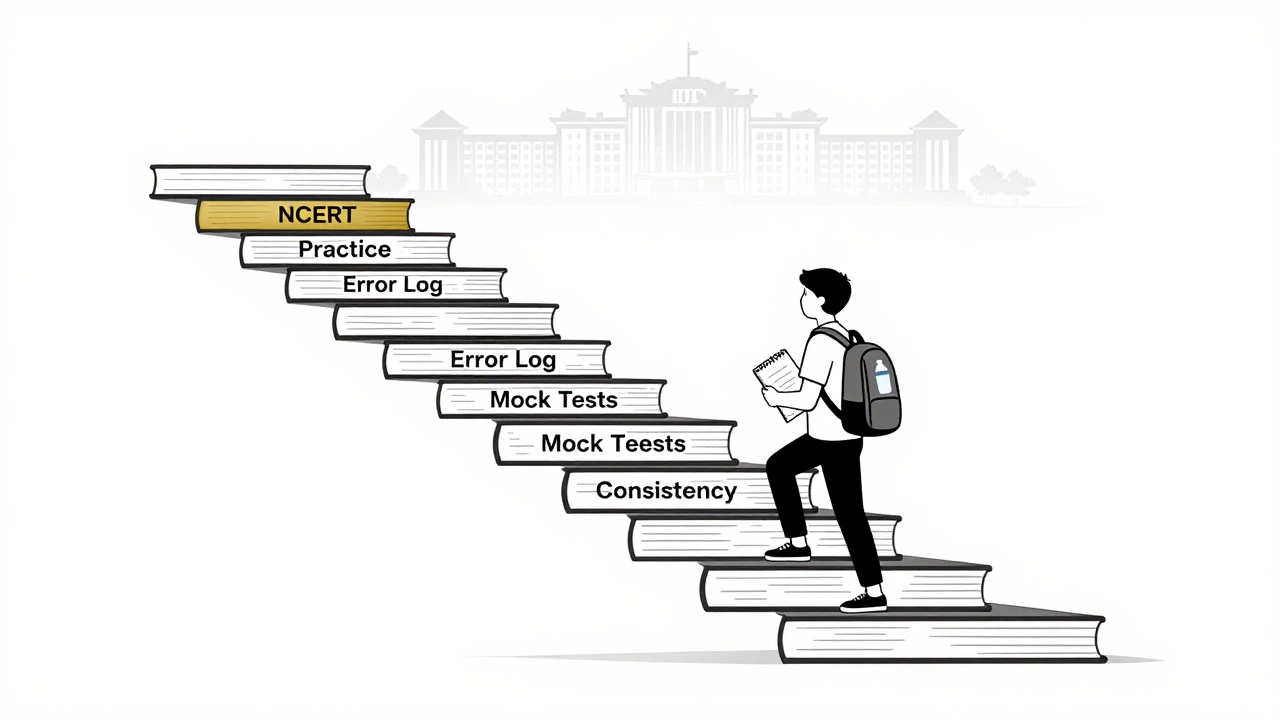
You don’t need ten books. You need three good ones and one habit: consistency.
Physics: NCERT → HC Verma (Vol. 1 & 2) → Past JEE papers
Chemistry: NCERT → OP Tandon (Organic) → JD Lee (Inorganic) → Past papers
Mathematics: NCERT → RD Sharma → Cengage (for advanced problem sets)
Don’t collect books. Use them. If you’re stuck on a topic, watch a 10-minute YouTube video from a trusted channel like Khan Academy or Unacademy JEE. Then close the tab and solve three problems yourself.
Online mock tests are critical. Use platforms like Allen, Resonance, or Embibe. Take at least one full mock every week after you’ve covered 3-4 chapters. Analyze your performance: Which subject dragged your score down? Which topic took too long? Adjust your schedule accordingly.
Stay mentally strong
Preparation isn’t just about books. It’s about your mind. You’ll have days when you feel like giving up. That’s normal. Even top rankers have them.
Here’s what helps:
- Get 7-8 hours of sleep. Cramming all night doesn’t work. Memory consolidation happens during sleep.
- Move your body. Walk 30 minutes a day. It clears mental fog better than coffee.
- Talk to someone - a parent, a friend, a teacher. Don’t bottle up stress.
- Track progress, not perfection. Did you solve 10 problems today? That’s 10 more than yesterday.
Compare yourself to your past self, not to someone else’s topper video. The JEE isn’t about being the smartest. It’s about being the most consistent.
When to start JEE Advanced prep
Don’t rush. Most students start JEE Advanced prep too early. You need a solid JEE Main foundation first. Only after you’re consistently scoring 180+ in JEE Main mocks should you shift focus to Advanced-level problems.
Advanced questions are trickier. They combine multiple concepts. For example: a question on rotational motion might involve friction, energy conservation, and torque - all in one. That’s why you need depth, not breadth.
Start Advanced prep 4-5 months before the exam. Use books like Irodov for Physics, Arihant for Maths, and MS Chouhan for Organic Chemistry. But again - only after NCERT and JEE Main practice are rock solid.
Final checklist before you begin
Before you open your first book, make sure you have:
- A quiet, distraction-free study space
- Printed copies of JEE syllabus (Physics, Chemistry, Maths)
- Access to at least one reliable mock test platform
- A notebook for error logs
- A calendar to mark weekly targets
That’s it. You don’t need fancy gadgets, expensive coaching, or a 100-page planner. Just focus. One chapter. One day. One problem at a time.
Can I start IIT JEE preparation in Class 11?
Yes, Class 11 is the ideal time to start. Most JEE toppers begin in Class 11 because the syllabus overlaps with school curriculum. You can learn concepts like kinematics, thermodynamics, and chemical bonding simultaneously for both school and JEE. Starting early gives you time to build depth without last-minute panic.
Is coaching necessary for IIT JEE?
No, coaching isn’t necessary, but it helps if you need structure. Many students crack JEE with self-study using NCERT, online videos, and mock tests. Coaching is useful if you struggle with discipline, need doubt-clearing sessions, or want access to quality test series. If you’re self-motivated and can stick to a schedule, you can do it alone.
How many hours should I study daily for JEE?
Aim for 6-7 focused hours daily, not 12 hours of half-attention. Quality matters more than quantity. Two hours of deep problem-solving with full concentration beats six hours of scrolling through notes. Include revision and mock tests in your count - they’re part of studying.
Can I crack JEE if I’m weak in Maths?
Yes, but you need to fix it early. Maths is the most scoring subject if you practice right. Start with NCERT exercises. Then move to RD Sharma. Focus on calculus, algebra, and coordinate geometry - they make up nearly 60% of the paper. Solve at least 20 problems daily from these topics. Consistency beats talent.
What’s the best way to revise for JEE?
Revise using active recall, not passive reading. Close your book and write down everything you remember about a topic - formulas, reactions, theorems. Then check what you missed. Use flashcards for reactions and formulas. Review your error log weekly. Revise one subject per week on Sundays. Don’t wait until the last month.
Next steps
Start today. Open your NCERT Chemistry textbook. Read the first page of the chapter on Atomic Structure. Highlight one thing you didn’t know before. Write it down. That’s your first win.
Don’t wait for the perfect time. There isn’t one. The best time to start was yesterday. The second best is now.

Anirudh Vaidya
I am an education consultant specializing in the Indian education system, and I enjoy exploring innovative teaching methods. My passion is writing about educational reforms and developments happening in India, trying to bring awareness to global audiences. I regularly contribute to various educational journals and participate in conferences worldwide. I believe in lifelong learning and am always keen to exchange ideas with fellow educators.