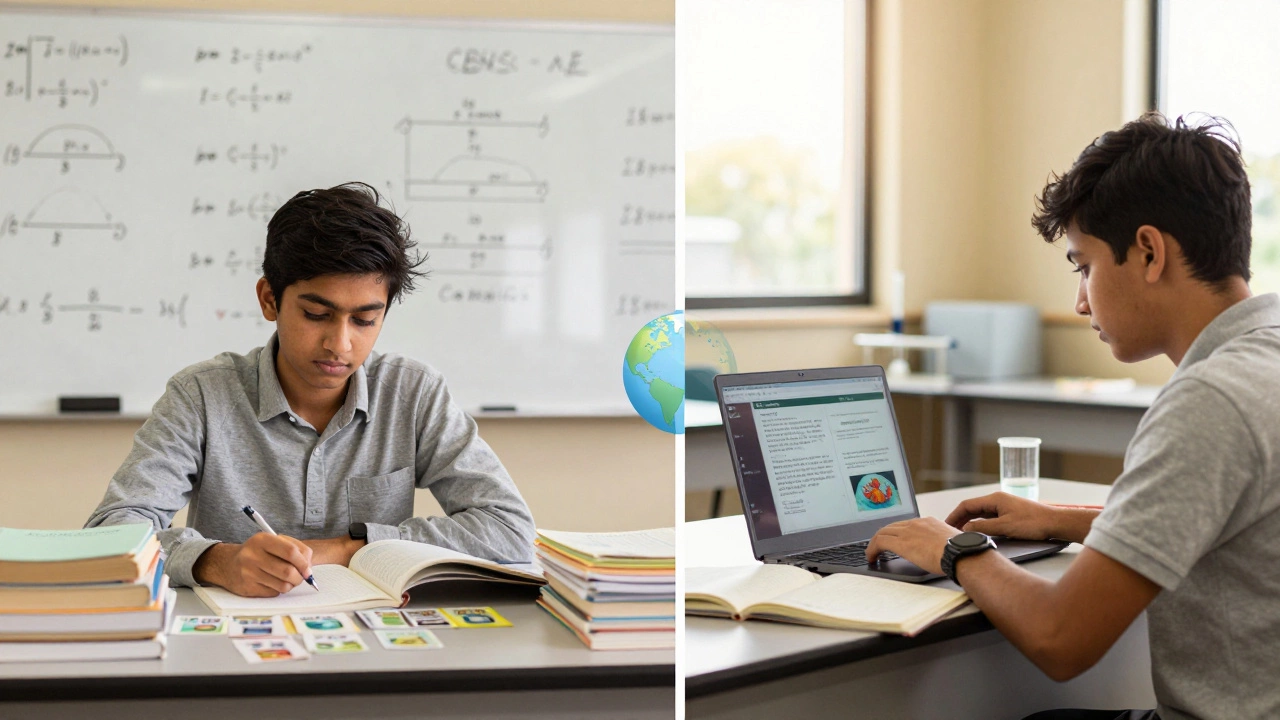
Choosing between the British curriculum and CBSE isn’t about which one is "better"-it’s about which one fits your child’s goals, learning style, and future plans. Parents often assume one is superior because it’s "more global" or "more rigorous," but the truth is more practical. The right choice depends on where your child will study next, what kind of learner they are, and what kind of life they want to build.
What CBSE actually teaches
CBSE, or the Central Board of Secondary Education, is the most common school board in India. It covers over 20,000 schools worldwide, including in Australia, the UAE, and Singapore. The syllabus is structured, predictable, and focused on core subjects: Math, Science, English, Social Science, and Hindi. It’s designed with national exams in mind-especially the Class 10 and Class 12 board exams, which heavily influence college admissions in India.
Students in CBSE schools typically learn through memorization, practice drills, and standardized testing. The emphasis is on mastering a fixed set of topics. For example, in Class 10 Science, students must know every formula in physics, every reaction in chemistry, and every diagram in biology. There’s little room for open-ended projects or student-led research. But this structure works well for students aiming for competitive exams like JEE, NEET, or AIIMS.
The CBSE syllabus is updated every few years, but the core remains unchanged. It’s aligned with Indian university requirements and government standards. If your child plans to study engineering, medicine, or public service in India, CBSE gives them the exact foundation they need.
What the British curriculum really looks like
The British curriculum, often delivered through Cambridge International (CIE) or Edexcel, is used in international schools across India and abroad. It’s divided into stages: Primary (ages 5-11), Lower Secondary (11-14), IGCSE (14-16), and A-Levels (16-18). Unlike CBSE, it doesn’t force students to study every subject equally. By age 14, they start choosing subjects they’re good at or passionate about.
IGCSE exams test understanding, not just recall. A biology question might ask: "Explain how climate change affects coral reefs using evidence from your experiments." That’s different from CBSE, where the same topic might be tested with a fill-in-the-blank about coral bleaching causes.
A-Levels are the real differentiator. Students usually take just 3-4 subjects in depth. A student interested in computer science might focus on Math, Physics, Computer Science, and Economics. They spend two years going deep into each, writing research papers, doing lab work, and developing critical thinking. This is what universities in the UK, Canada, Australia, and the US look for.
There’s also coursework-projects done over weeks or months, not just one final exam. This rewards consistency, not cramming. It’s less about perfect scores and more about showing growth and independent thought.
How exam pressure compares
CBSE students face high-stakes exams twice: Class 10 and Class 12. These exams determine whether they get into top engineering or medical colleges. The pressure is intense. Many students attend coaching centers after school, study 10-12 hours a day, and live under constant performance anxiety.
In the British system, exams matter too-but they’re spread out. IGCSEs are taken at 16, A-Levels at 18. There’s no single exam that decides everything. A student who bombs one IGCSE paper can still recover with strong A-Level results. The system allows for mistakes. It also gives students time to explore interests outside academics-debate club, robotics, volunteering.
Parents in Melbourne or Sydney often choose the British curriculum because they want their kids to develop resilience, not just grades. A child who learns how to manage a six-month project, present findings, and handle feedback is better prepared for university than one who can recite 500 biology definitions.
Which one prepares you for university abroad?
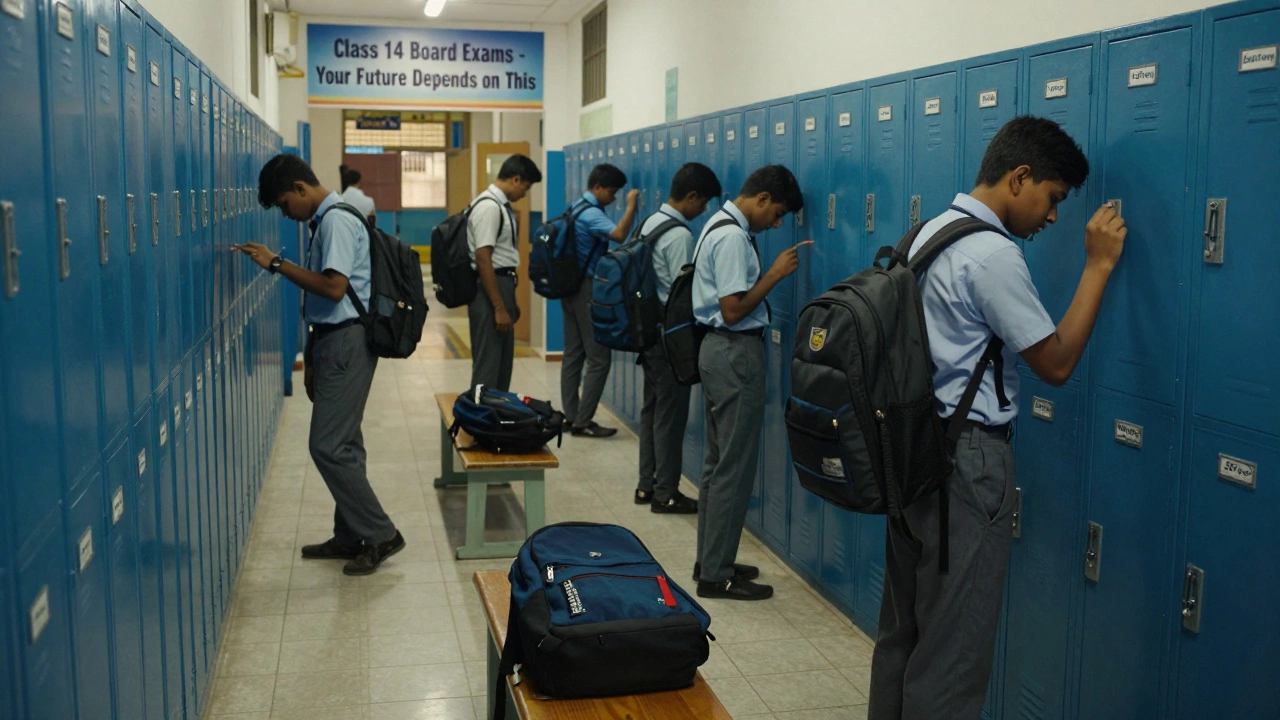
If your goal is to study in the UK, Canada, Australia, or the US, the British curriculum has a clear advantage. Universities there recognize A-Levels as a direct measure of academic ability. Top schools like Oxford, UCL, University of Toronto, and University of Melbourne accept A-Level grades directly. They don’t need to convert them.
CBSE scores are accepted too-but they’re often converted into GPA equivalents, which can be inconsistent. A 95% in CBSE might be treated as a 3.8 GPA by one university and a 3.5 by another. That uncertainty can hurt applications.
Also, British curriculum students usually have stronger English writing skills. A-Level essays require analysis, argument, and structure. CBSE English focuses on grammar, comprehension, and letter writing. For students applying to universities where essays and personal statements matter, that difference is real.
What about students staying in India?
If your child plans to study in India, CBSE is still the safest path. JEE Advanced, NEET, and CUET are all designed around the CBSE syllabus. Coaching institutes like Allen, FIITJEE, and Aakash build their entire curriculum around CBSE content. Switching to British curriculum after Class 8 means your child will need to relearn physics formulas, chemistry reactions, and math concepts from scratch.
There are exceptions. Some private Indian universities like Ashoka, O.P. Jindal, and Shiv Nadar accept A-Levels. But they’re still the minority. If your child wants to join IITs, NITs, or AIIMS, CBSE gives them the clearest, most direct route.
Cost and accessibility
CBSE schools are affordable. Fees range from ₹30,000 to ₹1.5 lakh per year in India. British curriculum schools? Often ₹2 lakh to ₹8 lakh per year. That’s a big difference. In Australia, British curriculum schools are mostly private and expensive. CBSE-affiliated schools are rare outside major cities.
Also, CBSE has a huge network of study materials, past papers, and online tutors. YouTube channels like Unacademy and Vedantu are built around CBSE. Finding a British curriculum tutor in a small Indian town? Much harder.

Real-life examples
Meet Priya. She studied CBSE in Delhi, scored 96% in Class 12, cracked JEE Advanced, and is now at IIT Bombay. She’s happy. Her path was hard, but it got her exactly where she wanted to go.
Then there’s Arjun. His family moved to Melbourne when he was 12. He switched to Cambridge IGCSE, then A-Levels. He took Math, Physics, and Computer Science. He didn’t need coaching-he learned by doing projects, coding apps, and joining hackathons. He got into the University of Melbourne with a scholarship. He’s now studying AI.
Neither path is wrong. Priya’s path led to a top Indian institute. Arjun’s led to an international degree with real-world skills. The difference? Their goals.
Which one suits your child?
Ask yourself these questions:
- Does your child thrive on structure and clear rules, or do they need freedom to explore?
- Are they aiming for engineering or medicine in India? Then CBSE.
- Do they love science but also want to write, code, or design? Then British curriculum gives them space.
- Will you move abroad in the next 5 years? British curriculum makes the transition smoother.
- Can you afford the higher fees and fewer resources for British schools?
There’s no universal winner. CBSE is a reliable ladder to top Indian institutions. The British curriculum is a flexible toolkit for global opportunities. One isn’t smarter. One isn’t harder. One is built for a specific destination. Choose based on where your child wants to end up-not what’s trending.
What if you’re still unsure?
Start with CBSE until Class 8. That’s when most students begin thinking about their future. By then, you’ll have a clearer picture: Is your child excelling in competitive exams? Do they enjoy deep research? Are they drawn to international programs? At that point, switching to British curriculum is still possible-and many families do exactly that.
Don’t panic because one system sounds "more global." Global doesn’t mean better. It just means different. The best education isn’t the one with the fanciest label. It’s the one that helps your child grow into the person they want to become.
Is CBSE easier than the British curriculum?
It’s not about ease-it’s about focus. CBSE is more predictable and exam-driven, which some students find easier to prepare for. The British curriculum asks for deeper thinking and independent work, which can feel harder if you’re used to memorizing facts. But students who enjoy research and projects often find it more engaging.
Can I switch from CBSE to British curriculum in Class 9?
Yes, many students do. Class 9 is a common transition point. You’ll need to adjust to different teaching styles-more project-based learning, less rote memorization. The syllabus won’t match exactly, so you may need to catch up on topics like experimental design or essay writing. But schools that offer the British curriculum usually provide bridging support.
Do British curriculum students do better in IIT JEE?
Rarely. JEE is built on the CBSE syllabus. British curriculum students who take JEE often need 1-2 years of intensive coaching to cover topics like organic chemistry, thermodynamics, and advanced math that aren’t in their curriculum. Some succeed, but it’s an uphill battle.
Is the British curriculum recognized in India?
Yes, but not equally. Top private universities like Ashoka, FLAME, and Symbiosis accept A-Levels. Public universities and government colleges still prioritize CBSE and state board scores. For competitive exams like JEE and NEET, CBSE remains the standard.
Which curriculum is better for studying in Australia?
The British curriculum is preferred. Australian universities understand A-Levels and IGCSEs directly. CBSE grades need conversion, which can lower your chances of scholarship offers. Students with A-Levels also tend to adapt faster to Australian teaching styles-less lecture-based, more discussion and critical analysis.

Anirudh Vaidya
I am an education consultant specializing in the Indian education system, and I enjoy exploring innovative teaching methods. My passion is writing about educational reforms and developments happening in India, trying to bring awareness to global audiences. I regularly contribute to various educational journals and participate in conferences worldwide. I believe in lifelong learning and am always keen to exchange ideas with fellow educators.