Coding Language Selector
Which language should you learn first?
Answer a few questions to get personalized guidance based on your goals.
If you’ve ever looked at a screen full of code and wondered how people even start, you’re not alone. The question which coding language should I learn first comes up every day - from high school students to career changers in their 40s. The truth? There’s no single right answer, but there are clear paths that work better for most people starting out.
Start with what you want to build
Too many beginners pick a language because it’s popular or because someone said it’s "the best." That’s like choosing a hammer because it’s the most sold tool in the hardware store - without knowing if you’re building a shelf or fixing a bike. Your first language should match your goal.If you want to make websites that move and react when you click things, JavaScript is your starting point. It’s the only language that runs directly in web browsers. Every site you’ve ever visited - from YouTube to your bank’s portal - uses JavaScript to make buttons work, show live updates, or animate menus. You can write your first JavaScript code right now by opening your browser’s developer tools and typing alert("Hello world");. It runs instantly. No setup. No install.
If you’re drawn to data, automation, or want to build tools that save you time - like sorting files, scraping prices, or analyzing spreadsheets - Python is the easiest path. It reads like plain English. You don’t need to remember complex syntax. Writing a script to rename 100 photos? In Python, it’s five lines. In other languages, it could be 50.
If you dream of making mobile apps, you might think you need Swift (for iPhone) or Kotlin (for Android). But here’s the catch: you don’t need to pick those yet. Most beginners start with Python or JavaScript, then move to mobile later. You’ll learn the core ideas first - variables, loops, functions - and those transfer.
Python: The quiet favorite of new coders
Python isn’t flashy. It doesn’t power social media feeds or real-time games. But it’s the most taught language in universities, bootcamps, and online courses worldwide. Why? Because it removes friction.Compare these two ways to print "Hello" in different languages:
- Python:
print("Hello") - Java:
public class Main { public static void main(String[] args) { System.out.println("Hello"); } }
One takes 5 seconds to understand. The other takes 5 minutes just to parse. For a beginner, that difference matters. You’re not fighting the language - you’re learning how to think like a programmer.
Python is used by NASA, Google, Instagram, and Netflix. It powers data science tools, AI models, and even the backend of many websites. You can build a simple web app, automate your files, or train a basic image recognizer - all with Python. And because it’s so readable, you’ll find tons of free tutorials, YouTube videos, and forums where people help each other.
One thing to watch: Python is slow compared to other languages. But for a beginner? Speed doesn’t matter. Clarity does.
JavaScript: The language of the web
If you want to build things people can see and interact with - buttons, forms, animations, live chat - JavaScript is the only choice. It’s not optional. Every website uses it. Every browser runs it. You can’t avoid it if you’re going into front-end development.But here’s the myth: you don’t need to learn HTML and CSS first to start JavaScript. You can begin writing simple scripts right away. For example, this one-line script changes the background color of a webpage:
document.body.style.backgroundColor = "lightblue";
Put that in a browser console, and boom - your page turns blue. That’s instant feedback. That’s motivation.
JavaScript also has frameworks like React and Vue that let you build complex apps. But again - don’t start there. Learn the basics first: variables, conditionals, loops, functions. Then learn how to manipulate the page. Then move to frameworks. Skipping the basics leads to confusion.
JavaScript’s biggest strength? You can see your code work immediately. No compilers. No terminals. Just open a browser, write a few lines, and see the result. That feedback loop keeps beginners going when things get hard.
What about Java, C++, or C#?
These languages are powerful. They’re used in big software systems, video games, banking apps, and operating systems. But they’re not beginner-friendly.Java requires you to understand classes, objects, and strict syntax before you can even print a sentence. C++ makes you manage memory manually - a concept that takes months to grasp. C# is great for Windows apps and Unity games, but it’s tied to Microsoft’s ecosystem, which adds complexity.
For someone just starting, these languages feel like trying to run a marathon before learning to walk. They’re not wrong - they’re just not the right first step.
There’s a reason no major coding bootcamp in Australia, the US, or Europe starts with Java or C++. They start with Python or JavaScript. Why? Because they’ve seen what works.
Real-world examples: What do people actually build?
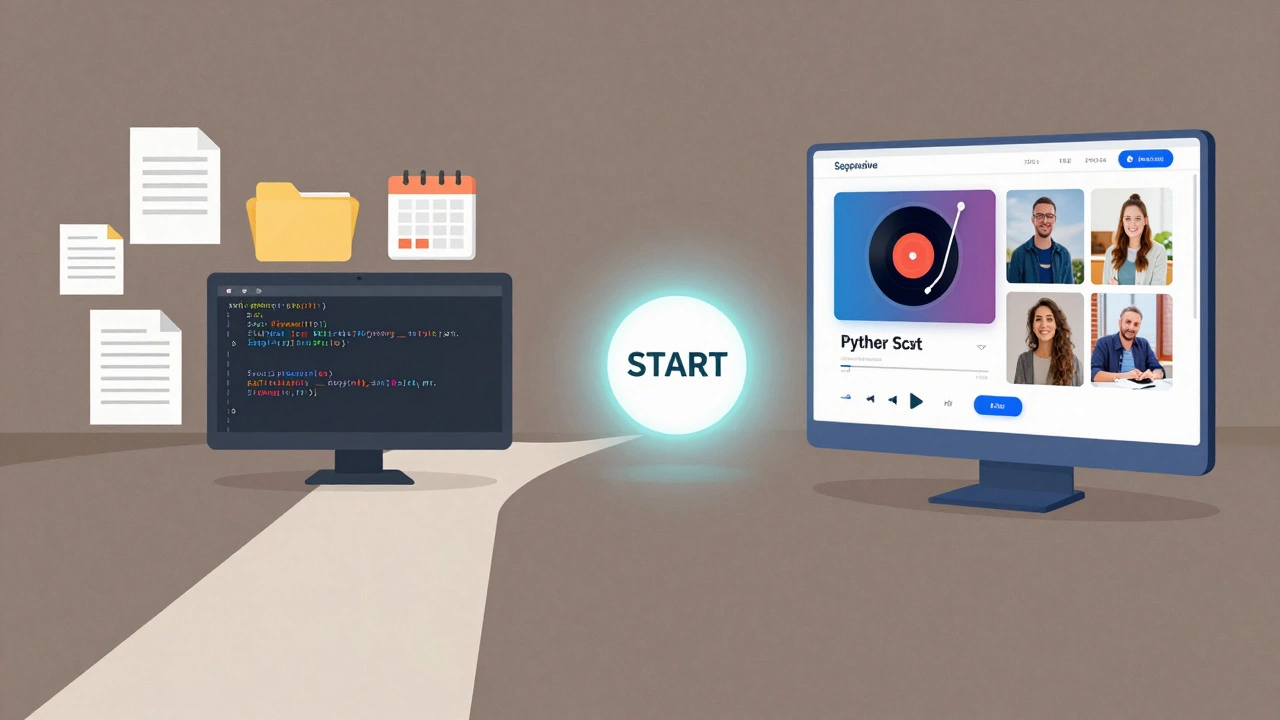
Let’s look at two real paths:Path 1: Sarah, 28, works in marketing. She wants to automate her daily tasks - pulling reports from Google Sheets, sending email reminders, organizing files. She learns Python. In two weeks, she writes a script that auto-sorts 300+ files into folders by date. She saves 3 hours a week. She’s hooked.
Path 2: Raj, 19, wants to make his own website for his band. He learns JavaScript. He builds a page with a play button that starts music, a photo gallery that slides, and a contact form that sends messages without reloading the page. He shares it with friends. They love it. He keeps learning.
Neither needed to know Java. Neither needed to write a thousand lines of code. They started small. They built something useful. That’s what keeps you going.
Common mistakes beginners make
Here’s what usually goes wrong:- Switching languages every week because "this one looks better." Stick with one for at least 6-8 weeks.
- Trying to learn too much at once - HTML, CSS, JavaScript, React, Node.js - all in a weekend. Focus on one thing. Master it.
- Waiting until you "know enough" to start building. You never know enough. Start building now. Break things. Fix them.
- Comparing yourself to people who’ve coded for 10 years. You’re not supposed to be them yet. You’re supposed to be you - starting.
The most successful beginners aren’t the smartest. They’re the ones who keep going even when it’s frustrating.
What’s next after your first language?
Once you’re comfortable with Python or JavaScript - meaning you can write a small program without Googling every line - you’re ready for the next step.With Python: Learn how to use libraries like Pandas (for data), Flask (for web apps), or Requests (to pull data from websites). Build a weather app that shows forecasts. Or a tool that tracks your expenses.
With JavaScript: Learn HTML and CSS properly. Then try building a to-do list app that saves items to your browser. Then move to React. Then try connecting it to a free backend like Firebase.
You don’t need a degree. You don’t need a fancy course. You need to build. One small thing. Then another. Then another.
Final advice: Don’t overthink it
Pick Python if you want to automate, analyze, or build tools. Pick JavaScript if you want to make websites that people can use. Both are free. Both have massive communities. Both lead to jobs.There’s no perfect language. There’s only the one you start with - and the one you stick with.
Open your computer. Open a text editor. Type your first line. Don’t wait for tomorrow. Start today.

Anirudh Vaidya
I am an education consultant specializing in the Indian education system, and I enjoy exploring innovative teaching methods. My passion is writing about educational reforms and developments happening in India, trying to bring awareness to global audiences. I regularly contribute to various educational journals and participate in conferences worldwide. I believe in lifelong learning and am always keen to exchange ideas with fellow educators.