
Post-MBA Career Path Finder
Define Your Goals
Recommended Path
Select your criteria and click "Analyze Best Path" to see your recommendation.
You spent years grinding for your MBA is a Master of Business Administration degree that prepares students for leadership roles in business.. You networked, you balanced work and study, and you finally landed that promotion. But now you’re looking at the ceiling. Maybe you want to move into C-suite strategy, switch to academia, or simply signal the highest possible level of expertise in your field. The question on your mind is simple but tricky: What degree is actually higher than an MBA?
The short answer is a doctoral degree. However, "doctoral" doesn’t mean just one thing in the business world. It splits into two distinct paths: the academic route (PhD) and the professional/executive route (DBA). There are also specialized master’s degrees and executive fellowships that sit alongside or above an MBA depending on your career goals.
The Two Main Paths: PhD vs. DBA
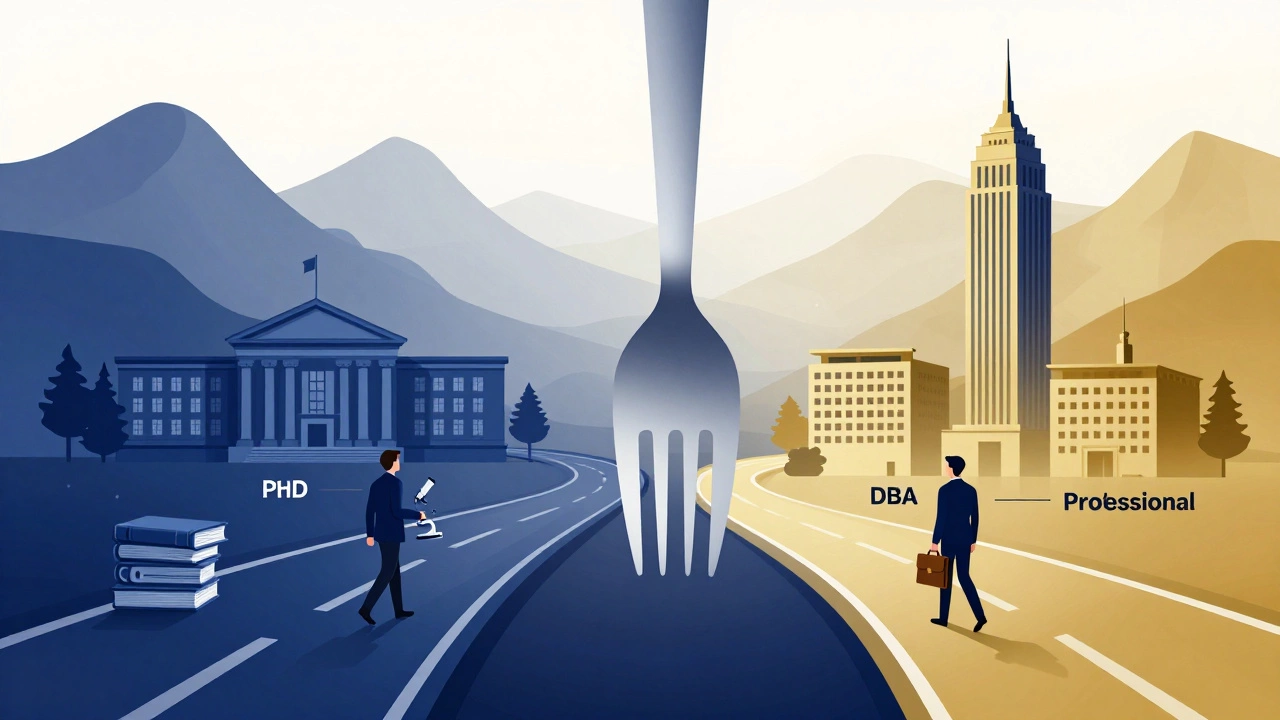
When people ask what comes after an MBA, they usually hit a fork in the road. One path leads to research and theory; the other leads to advanced practice and leadership. Understanding this difference is crucial because picking the wrong one can waste three to five years of your life.
PhD in Management is a research-intensive doctorate focused on creating new business theories and conducting original studies. This is the gold standard if you want to become a professor at a top-tier business school. A PhD program typically takes four to six years. You will spend most of your time reading journals, designing experiments, and writing a dissertation that contributes something new to the body of knowledge. If you enjoy asking "why" and digging deep into data to find patterns, this might be your fit. But if you prefer solving immediate company problems over abstract theorizing, a PhD will feel like a mismatch.
On the other side, you have the Doctor of Business Administration (DBA) is a professional doctorate designed for experienced executives who want to apply advanced research methods to real-world business challenges. Think of the DBA as the practical cousin of the PhD. It usually takes three to four years and is often part-time, allowing you to keep working while you study. Instead of pure theory, you focus on applying research to solve complex issues in your organization. Many senior executives pursue a DBA to validate their experience with a terminal degree without leaving the corporate ladder.
| Feature | PhD in Management | DBA (Doctor of Business Administration) |
|---|---|---|
| Primary Goal | Create new theory / Academia | Apply research to practice / Executive Leadership |
| Duration | 4-6 years (Full-time) | 3-5 years (Part-time/Hybrid) |
| Target Audience | Aspiring Professors, Researchers | Senior Executives, Consultants, Entrepreneurs |
| Dissertation Focus | Theoretical contribution | Practical problem-solving |
| Outcome | Tenure-track faculty position | C-Suite role, High-level consulting |
Specialized Professional Doctorates
Beyond the general management tracks, there are specialized doctorates that offer deeper expertise in specific functional areas. These degrees are "higher" than an MBA in terms of depth and credentialing within their niche.
If you are in healthcare administration, a Doctor of Health Administration (DHA) is a doctoral degree focused on the leadership and management of healthcare organizations. is a strong option. It combines business acumen with specific regulatory and operational knowledge of hospitals and health systems. Similarly, those in information technology might look at a Doctor of Information Technology (DIT) is a professional doctorate focusing on the strategic application of IT in organizational settings.. Unlike a PhD in Computer Science, which is heavily technical, a DIT focuses on how technology drives business strategy-a perfect bridge for an MBA graduate moving into CIO roles.
For educators or training leaders, an EdD (Doctor of Education) is a professional doctorate in education leadership and policy. can be more relevant than a general business doctorate. It allows you to lead large-scale educational institutions or corporate learning departments with a doctoral-level understanding of pedagogy and organizational behavior.
Executive Fellowships and Certificates
Not everyone wants another multi-year degree. For many seasoned leaders, the value lies in peer networking and high-level strategic thinking rather than a diploma. This is where executive fellowships come in.
Programs like the Stanford Institute for Innovation in Developing Economies (SIIDE) is an executive education program offering advanced strategic insights for global leaders. or Harvard Business School’s Senior Executive Program (SEP) are not degrees, but they carry immense weight. They are often attended by CEOs and government ministers. While they don’t give you the title "Dr.," they signal that you operate at the highest tier of decision-making. In some industries, particularly finance and tech, these certificates are viewed as equivalent to or even more prestigious than a generic DBA because of the rigor of selection and the caliber of peers.
When Is a Second Master’s Degree Better?
Sometimes, going "higher" isn’t about getting a doctorate. It’s about pivoting. If your MBA was generalist, you might lack the hard skills needed for a specific role. In this case, a second master’s degree can be more valuable than a doctorate.
Consider a Master of Laws (LL.M.) is a postgraduate law degree for those who already hold a basic law degree or related qualification. if you are moving into compliance or corporate governance. An MBA gives you the business context, but an LL.M. gives you the legal authority. Another example is a Master of Public Health (MPH) is a master's degree preparing professionals for careers in public health and community wellness. for those entering the non-profit or government health sector. These dual-credential profiles (MBA + LL.M. or MBA + MPH) are rare and highly sought after because they combine strategic vision with specialized technical competence.

How to Choose the Right Path
Deciding what to do after your MBA requires honest self-reflection. Ask yourself these three questions:
- Do I want to teach or research? If yes, pursue a PhD. No other degree opens the door to tenure-track positions at reputable universities.
- Do I want to accelerate my executive career? If yes, a DBA or an Executive Fellowship is likely better. They respect your time and enhance your current trajectory without pulling you away from the workforce.
- Am I changing industries? If yes, consider a specialized master’s or certificate that bridges the gap between your business background and the new industry’s requirements.
Remember, a higher degree is not automatically a better degree. It is only better if it aligns with your specific career objectives. An MBA is already a powerful credential. Adding a doctorate should amplify your existing strengths, not distract from them.
Cost and ROI Considerations
Let’s talk money. Doctoral programs are expensive. A full-time PhD might offer stipends, effectively paying you to study, but you lose potential salary income for several years. A DBA, however, can cost anywhere from $50,000 to over $100,000, and you continue to work. You need to calculate the return on investment carefully.
In many cases, the ROI of a DBA is not immediate salary bumps but long-term positioning. It helps you break through the "glass ceiling" into board-level positions or high-level consulting firms that require a terminal degree. For PhDs, the ROI is tied to academic salaries and grants, which vary wildly by institution and field. Always check employment outcomes for graduates of the specific programs you are considering.
Is a DBA considered equal to a PhD?
In terms of academic rank, both are terminal doctoral degrees, so they are equal in status. However, they serve different purposes. A PhD is focused on theoretical research and academia, while a DBA is focused on applied research and executive practice. Employers in industry often view them as comparable, but academic institutions may prefer PhDs for teaching roles.
Can I get a job without a PhD after an MBA?
Absolutely. Most MBA graduates build successful careers in consulting, finance, marketing, and operations without ever pursuing a doctorate. A PhD is primarily necessary if you want to become a university professor or conduct high-level independent research. For corporate leadership, experience and an MBA are often sufficient.
How long does it take to complete a DBA?
Most DBA programs are designed for working professionals and take between 3 to 5 years to complete. Some accelerated programs exist, but the majority follow a part-time schedule where students attend classes on weekends or online while maintaining full-time employment.
Is an Executive MBA (EMBA) higher than an MBA?
An EMBA is not technically "higher" than an MBA; it is a parallel track designed for experienced executives. Both are master’s degrees. The EMBA curriculum assumes prior managerial experience and focuses more on strategic leadership and peer networking, whereas a traditional MBA often includes foundational business courses.
What is the difference between a DM and a DBA?
DM stands for Doctor of Management. In many cases, a DM and a DBA are very similar, both being professional doctorates. The distinction often depends on the university’s naming convention. Some schools use DBA for business-focused programs and DM for broader management or organizational behavior focuses. Check the specific curriculum to understand the difference.

Anirudh Vaidya
I am an education consultant specializing in the Indian education system, and I enjoy exploring innovative teaching methods. My passion is writing about educational reforms and developments happening in India, trying to bring awareness to global audiences. I regularly contribute to various educational journals and participate in conferences worldwide. I believe in lifelong learning and am always keen to exchange ideas with fellow educators.